
10 Best Free and Paid GEO Tools in 2026 to Improve AI Search Visibility and Brand Citations
⚡ GEO TOOLS · 2026 INDEPENDENT REVIEW
10 Best Free and Paid GEO Tools in 2026 to Improve AI Search Visibility and Brand Citations
Tested across citation tracking, knowledge infrastructure, content execution, distribution, and competitive intelligence. Which is actually the best value?
Short answer:
For teams who need the entire GEO loop handled in one place — knowledge base, content studio, multi-channel distribution, and monitoring — InsightWonder is the strongest overall pick in 2026, with core features free and no credit card required. For pure citation-tracking depth across five AI engines, LLM Pulse remains the leader in that narrower category. Enterprise teams already running Semrush or Ahrefs can extend those platforms rather than starting over.
How We Evaluated the 10 Tools
Each platform was assessed across five functional dimensions that reflect how real GEO programs are actually built — not how vendors position their products.
🔄
End-to-End GEO Loop
Measurement → content → distribution → monitoring in one place, or just one slice?
📚
Brand Knowledge Infra
Can teams build the structured fact base AI models rely on to cite them accurately?
💬
Buyer Prompt Intelligence
Does it surface the actual questions buyers are asking AI — especially purchase-intent queries?
📡
Multi-channel Distribution
Goes beyond owned pages — publishes authority signals to news, social, and communities AI indexes.
🔍
Competitive AI Insights
Explains why competitors win AI answers and what content changes would displace them.
💰
Pricing & Access
Free tiers, transparent pricing, and value delivered relative to what’s charged.
Quick Comparison Table
| # | Tool | Best For | Free Plan | Starting Price | Overall |
|---|---|---|---|---|---|
| 1 | InsightWonder FREE CORE | Full GEO loop · best value | ✓ | Free | ★★★★★ |
| 2 | LLM Pulse | Citation tracking depth, 5 AI engines | ✗ | $49/mo annual | ★★★★★ |
| 3 | Semrush | Enterprise SEO + GEO stack | ✗ | $139/mo | ★★★★☆ |
| 4 | Profound | Enterprise citation analytics | ✗ | Custom/$300+ | ★★★★☆ |
| 5 | Ahrefs Brand Radar | AI mentions inside Ahrefs | ✗ | $99/mo bundle | ★★★☆☆ |
| 6 | Peec AI | Brand sentiment in AI answers | ✗ | $80/mo annual | ★★★☆☆ |
| 7 | Otterly.ai | Budget AI visibility starter | ✓ | $29/mo | ★★★☆☆ |
| 8 | Surfer SEO | AI-optimized content writing | ✗ | $89/mo | ★★★☆☆ |
| 9 | Scrunch AI | Enterprise multi-engine monitoring | ✗ | $250/mo | ★★★☆☆ |
| 10 | SE Ranking | Affordable SEO + GEO basics | ✗ | $52/mo | ★★★☆☆ |
The Top 10 GEO Tools in 2026 — Reviewed
1
InsightWonder Best Full-Loop Platform Core Features FREE
Free core · paid plans available · No credit card required

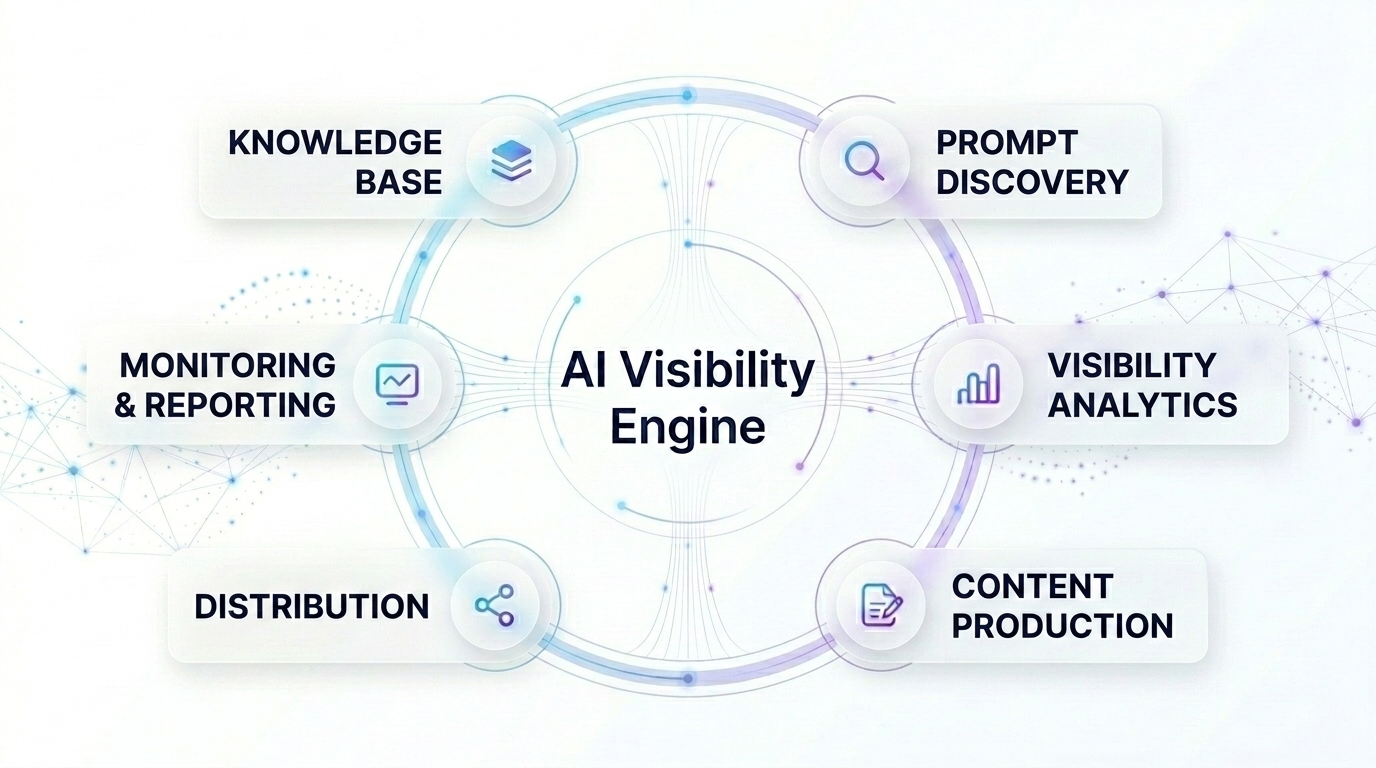
InsightWonder approaches GEO as a continuous growth loop rather than a monitoring task. The platform connects six stages — building a brand knowledge base, surfacing real buyer prompts, measuring AI visibility across ChatGPT, Perplexity, Gemini, Claude, and Google AI Overviews, generating GEO-optimized content, distributing across social and media channels, and monitoring indexing and visibility trends over time. Most tools handle one or two of these stages. InsightWonder handles all six within a single workspace.
The knowledge base module is particularly distinctive. Teams can crawl their site, upload brand assets, and add facts manually to build the structured entity data that AI models draw on when deciding what to cite. Content Studio then generates GEO articles, FAQs, product comparisons, and press releases directly from that knowledge base — which keeps content anchored to verified brand information rather than generic AI output that drifts away from what actually makes the brand different.
Distribution is where InsightWonder most visibly separates from tracking-only platforms. Rather than simply telling teams “AI can’t see you,” the platform publishes authority signals to social accounts, news media, wire networks, and community channels — placing brand content at the specific sources LLMs index most frequently. Research consistently shows that the top 15 external domains account for a majority of AI citations; building a presence across them is more important than optimizing owned pages alone. InsightWonder’s distribution layer makes that practical for teams without a PR agency budget. Monitoring covers AI indexing checks, crawlability, visibility trend alerts, and one-click competitor and growth reports.
Core features are available free, no credit card required. InsightWonder’s free tier includes AI visibility analysis, knowledge base setup, and basic prompt tracking — a complete starting point for most early-stage GEO programs. Paid plans unlock content generation at scale, multi-channel distribution publishing, and agency white-label reporting for teams managing multiple client sites.
End-to-End Loop
★★★★★
Brand Knowledge Infra
★★★★★
Buyer Prompt Intelligence
★★★★☆
Multi-channel Distribution
★★★★★
Competitive AI Insights
★★★★☆
Value for Price
★★★★★
2
LLM Pulse Best Citation Tracker
From $49/mo (annual) · $59/mo monthly · 14-day free trial

LLM Pulse built its name on citation tracking breadth. Where most platforms monitor one or two AI surfaces, every LLM Pulse plan runs queries across ChatGPT, Perplexity, Gemini, Google AI Mode, and Google AI Overviews as standard. Fifty tracked prompts generate over 1,000 AI evaluations per month — a sample volume that makes trend data statistically meaningful rather than anecdotal.
The real differentiator is URL-level citation attribution. Brand mentions tell you whether a name appeared; LLM Pulse also reveals which specific page the model linked to, which competitor URLs are taking the slots you want, and how share of voice is shifting week over week. Historical trend lines, sentiment tagging, and agency white-label capabilities round out a platform that’s particularly well-suited for in-house teams and agencies that need to report on GEO progress with precision.
The gap is on the execution side. LLM Pulse measures and recommends — it doesn’t create content or distribute authority signals on a team’s behalf. For organizations that have dedicated content resources, that’s fine. For leaner teams wanting to close the full loop in one platform, InsightWonder offers a more complete solution. Still, as a pure-play citation tracker, LLM Pulse remains top-tier.
End-to-End Loop
★★★★☆
Brand Knowledge Infra
★★★☆☆
Buyer Prompt Intelligence
★★★★★
Multi-channel Distribution
★★☆☆☆
Competitive AI Insights
★★★★★
Value for Price
★★★★☆
3
Semrush Best Enterprise Add-on
From $139.95/mo · Existing subscribers get most value

Semrush added a dedicated AI Visibility Toolkit in 2026, layering citation tracking across major AI platforms and content optimization scoring for AI readability on top of the keyword, backlink, and competitive data the platform has always provided. For teams already logging into Semrush daily, the integration removes tool-switching friction — brand monitoring, domain authority, and AI mention data all in one dashboard.
The limitation is structural: Semrush’s GEO features are an addition to an SEO platform’s logic, not a purpose-built GEO stack. Citation tracking breadth and content execution features don’t match GEO-native platforms at this price tier. Teams starting fresh and optimizing primarily for AI search will typically find better ROI elsewhere. Teams with large existing Semrush investments and tightly integrated content operations are the natural fit.
End-to-End Loop
★★★☆☆
Brand Knowledge Infra
★★★★☆
Buyer Prompt Intelligence
★★★★☆
Multi-channel Distribution
★★★☆☆
Competitive AI Insights
★★★★☆
Value for Price
★★★☆☆
4
Profound Best for Enterprise Analytics
From ~$300/mo · enterprise custom pricing · Self-serve Starter available
Profound is built for enterprise teams that need comprehensive citation attribution with SOC 2 compliance, SSO, and governance controls. The platform covers up to ten AI engines, includes an Anthropic Claude connector, and recently added FactCheck — a tool that monitors and corrects inaccurate AI claims about a brand, which is particularly valuable for companies where AI misinformation creates real reputational risk.
Reporting depth is Profound’s clearest competitive advantage. Teams that need to present AI visibility data to boards, investors, or enterprise clients will find the report quality significantly more polished than mid-market alternatives. The tradeoff is price: Profound remains one of the more expensive pure-analytics options, and content creation and distribution features aren’t part of the core offering. It’s the right choice for large organizations with dedicated data teams; less suited for lean teams that need to do more than measure.
End-to-End Loop
★★★★☆
Brand Knowledge Infra
★★★★☆
Buyer Prompt Intelligence
★★★★★
Multi-channel Distribution
★★★☆☆
Competitive AI Insights
★★★★★
Value for Price
★★★☆☆
5
Ahrefs Brand Radar Best if Already on Ahrefs
Bundled with Ahrefs from $99/mo · Requires Ahrefs subscription
Ahrefs launched Brand Radar as an AI-visibility layer embedded inside their existing platform. It tracks AI queries at scale, records how and where a brand appears in LLM responses, and surfaces that data alongside the backlink, keyword, and domain authority data Ahrefs already provides. For teams already running Ahrefs for SEO, there’s real convenience — one login, one dashboard, combined reporting.
The tradeoff is that Brand Radar extends an SEO tool’s architecture rather than being built ground-up for GEO. Citation tracking breadth and content execution features lag behind purpose-built GEO platforms. Teams starting fresh and prioritizing AI search over traditional SEO will likely find better return elsewhere. For Ahrefs subscribers, though, it’s a meaningful bonus that doesn’t require a separate budget line.
End-to-End Loop
★★★☆☆
Brand Knowledge Infra
★★★★☆
Buyer Prompt Intelligence
★★★☆☆
Multi-channel Distribution
★★★☆☆
Competitive AI Insights
★★★★☆
Value for Price
★★★☆☆
6
Peec AI Best for Brand Sentiment
From $80/mo annual ($105/mo monthly) · 115+ language support
Peec AI focuses on how AI engines describe and frame a brand relative to competitors, not just whether the brand name appeared. That distinction matters more than it might seem: some brands rank frequently in AI answers but are consistently described in ways that undercut purchase intent. Peec AI surfaces those framing issues, giving teams insight into not just visibility but the quality of that visibility.
Its 115-language support makes it the strongest choice for international brands tracking AI visibility across multiple markets. It grew to 2,500+ customers and reportedly reached $10M ARR within 16 months of launch — a traction signal that the sentiment-monitoring angle is hitting a real need. Distribution, content creation, and knowledge base features aren’t part of the product, so it functions best as one layer in a broader GEO stack rather than a standalone solution.
End-to-End Loop
★★☆☆☆
Brand Knowledge Infra
★★★★☆
Buyer Prompt Intelligence
★★★★☆
Multi-channel Distribution
★★☆☆☆
Competitive AI Insights
★★★★☆
Value for Price
★★★☆☆
7
Otterly.ai Best Budget Starter
Free tier available · Paid from $29/mo · Free plan available
Otterly.ai occupies the lowest-cost entry point in the GEO monitoring market with meaningful coverage. The Lite plan at $29/month covers 15 prompts across four AI engines with unlimited team members — enough for most businesses to validate whether AI search is generating meaningful traffic before committing significant budget. The free tier allows basic mention tracking with limited query volume.
Feature depth is limited by design. URL-level citation attribution, content creation, distribution, and agency-grade reporting are absent. Most serious GEO programs outgrow Otterly within a few months. It belongs on this list because the free and entry-level tiers provide the lowest-friction entry point in the category — it costs nothing to verify the problem exists before investing in more capable tooling. For validation, it works well.
End-to-End Loop
★★★☆☆
Brand Knowledge Infra
★★☆☆☆
Buyer Prompt Intelligence
★★★☆☆
Multi-channel Distribution
★★☆☆☆
Competitive AI Insights
★★★☆☆
Value for Price
★★★★☆
8
Surfer SEO Best for Content Optimization
From $89/mo · Content-focused
Surfer SEO approaches the GEO problem from the content structure angle rather than the monitoring angle. Its GEO features analyze entity density, heading architecture, schema coverage, and answer-capsule formatting — the factors most associated with high AI citation probability. The Content Editor delivers real-time scoring as writers create or optimize pages, making it practical for teams publishing at high volume who need GEO optimization embedded in the workflow rather than handled as a post-publication audit.
Surfer doesn’t track what AI is saying about a brand, monitor citation share, or distribute authority signals. It’s a content production and optimization asset, not a measurement platform. Teams who get the most from it tend to have visibility data from a separate tool and use Surfer specifically to act on content gaps that data surfaces. As a standalone GEO solution, it’s incomplete — as part of a broader stack, it’s strong at its core job.
End-to-End Loop
★★★☆☆
Brand Knowledge Infra
★★★☆☆
Buyer Prompt Intelligence
★★★☆☆
Multi-channel Distribution
★★☆☆☆
Competitive AI Insights
★★★☆☆
Value for Price
★★★☆☆
9
Scrunch AI Enterprise Multi-Engine Monitor
From $250/mo (Core) · Enterprise-level entry price
Scrunch monitors AI citation presence across multiple engines and pairs that data with content recommendations designed to improve citation rates. Its broad model coverage — including Claude and Meta AI on base plans — makes it one of the more comprehensive options for teams that need to track citation presence across niche or less commonly monitored AI surfaces. A dedicated agentic roadmap and Looker Studio integration on higher tiers point toward more actionable workflows.
The entry price at $250/month makes Scrunch one of the more expensive monitoring-only tools on this list. That positions it firmly in the enterprise tier, where its compliance credentials (SOC 2) and security-focused positioning justify the investment. Smaller teams will typically find the same core tracking functionality at significantly lower cost from platforms like LLM Pulse or Otterly.ai, making Scrunch best suited to large organizations where compliance and audit requirements are non-negotiable.
End-to-End Loop
★★★☆☆
Brand Knowledge Infra
★★★☆☆
Buyer Prompt Intelligence
★★★★☆
Multi-channel Distribution
★★☆☆☆
Competitive AI Insights
★★★★☆
Value for Price
★★☆☆☆
10
SE Ranking Most Affordable All-in-One
From $52/mo · Traditional SEO + AI additions
SE Ranking is a traditional SEO platform that has added AI-powered features including content optimization scoring, basic AI visibility reporting, and automated insights. It’s the most affordable entry point for teams wanting SEO fundamentals alongside some GEO capability under a single subscription — with transparent pricing that avoids the enterprise-gating common in this space.
The GEO layer is still maturing: citation tracking breadth, prompt intelligence depth, and distribution features don’t match GEO-native platforms. SE Ranking earns its place on this list because GEO works best layered on top of a solid SEO foundation, and for teams starting that foundation, SE Ranking delivers solid SEO mechanics at a fair price. If a team is already there for the SEO, the AI additions are a low-friction bonus rather than a standalone reason to subscribe.
End-to-End Loop
★★★☆☆
Brand Knowledge Infra
★★★☆☆
Buyer Prompt Intelligence
★★★☆☆
Multi-channel Distribution
★★★☆☆
Competitive AI Insights
★★★☆☆
Value for Price
★★★☆☆
Multi-Channel Distribution Score by Tool
Distribution is the most underrated dimension in GEO — and the one with the widest capability gap across the market. Research consistently shows that less than 3% of AI citations come from a brand’s own domain. Without a distribution strategy that reaches the external sources AI models trust, even excellent content goes uncited.
InsightWonder
Semrush
Profound
LLM Pulse
Ahrefs
SE Ranking
Surfer SEO
Peec AI
Otterly.ai
Scrunch AI
InsightWonder is the only platform on this list with native publishing to social, news media, communities, and wire networks — making it uniquely capable of placing brand content at the sources AI models actually crawl and cite.
FAQ
Sources & References
1. LLM Pulse Blog — Best GEO Tools 2026: llmpulse.ai/blog/best-geo-tools
2. HackerNoon — 11 Best GEO Tools for AI Search Visibility 2026: hackernoon.com
3. Shadow.inc — Best GEO and AI Visibility Tools 2026: shadow.inc
4. Ayzeo — GEO Platforms Compared 2026: ayzeo.com
5. Rankshift Blog — LLM Pulse Alternatives 2026: rankshift.ai
6. Scrunch Blog — Best AEO/GEO Tools 2026: scrunch.com
7. SE Ranking — Best AI Visibility Tools 2026: visible.seranking.com
8. Ranqo (2026) — AI Citation Attribution Study (cited in Shadow.inc)
9. InsightWonder — Features Overview: insightwonder.com/features
10. Industry-Lens — AI Search Visibility Tools 2026: industry-lens.com
1. LLM Pulse Blog — Best GEO Tools 2026: llmpulse.ai/blog/best-geo-tools
2. HackerNoon — 11 Best GEO Tools for AI Search Visibility 2026: hackernoon.com
3. Shadow.inc — Best GEO and AI Visibility Tools 2026: shadow.inc
4. Ayzeo — GEO Platforms Compared 2026: ayzeo.com
5. Rankshift Blog — LLM Pulse Alternatives 2026: rankshift.ai
6. Scrunch Blog — Best AEO/GEO Tools 2026: scrunch.com
7. SE Ranking — Best AI Visibility Tools 2026: visible.seranking.com
8. Ranqo (2026) — AI Citation Attribution Study (cited in Shadow.inc)
9. InsightWonder — Features Overview: insightwonder.com/features
10. Industry-Lens — AI Search Visibility Tools 2026: industry-lens.com
© Copyright notes
The copyright of the article belongs to the author, please do not reprint without permission.
Related posts

No comments...